How Much Do Instagram Ads Cost in 2025? (+ Tips to Optimize)

How much do Instagram ads cost? If you’re a marketer or a small business owner, you’ve likely asked yourself this question – and for good reason! In North America alone, there are 225 million Instagram users, and last year, Instagram made up 40.6% of Facebook’s revenue. This was up from only 22.9% five years ago. This showcases that Instagram is no longer just a place to share pics of your dogs (but please keep doing that!). It’s a vehicle for brand discovery and sales intent.
While Instagram has reach and extensive targeting capabilities, ad costs can vary based on your goals, audience targeting, and time of year. Q4 is the undisputed Super Bowl for marketers. This is when the competition and the CPMs are at their highest.
In this guide, we’ll break down how much do Instagram ads cost. We’ll share optimization and creative levers marketers have to get the most out of their Instagram ads investment.
👉Let’s explore what goes into Instagram advertiser costs and how you can make every dollar count.
Need help running Instagram ads? Partner with AdParlor and let our team of experts maximize your Instagram spending. Let’s connect!
Table of Contents
Instagram Ads Costs Compared to Ads on Other Social Media Platforms
Factors that Determine Instagram Ads Cost
Why Instagram Ads Are Worth the Investment
Best Practices to Optimize Your Instagram Ad Spend
Types of Instagram Ads You Can Run
Instagram Ads Cost Structure
Instagram advertising allows brands to promote their content directly within a user’s feed, Stories, Reels, or Explore tab. By catering your creative approach to each placement, brands can feel native to the content on the Instagram app. But how much do Instagram ads cost?
It depends! Instagram advertising costs take place in an ad auction. This means it can be a little unpredictable at times. Your bid, expected action rates, and ad quality all inform ad costs.
Your campaign goals can influence Instagram ad costs. As you move down the funnel, your ask becomes greater. You don’t want just impressions; you want consumers to complete specific actions. This means the Meta algorithm needs to optimize for harder-to-predict actions. Lower-funnel campaigns target smaller, higher-intent audiences, so each touchpoint is more valuable… and the cost reflects this.Media buying is equal parts math and art with a little bit of magic sprinkled in. Here are some general baselines for Instagram advertising costs throughout the funnel, looking at CPC, CPM, and CPE.
| Benchmarks – Awareness Goals | |
|---|---|
| Metric | Average Cost (Q1 2025) |
| Cost Per Click (CPC) | $2.00 – $3.00 |
| Cost Per 1,000 Impressions (CPM) | $2.00 – $3.00 |
| Cost Per Engagement (CPE) | $0.10 – $0.20 |
| Benchmarks – Website Traffic Goals | |
|---|---|
| Metric | Average Cost (Q1 2025) |
| Cost Per Click (CPC) | $0.20 – $0.50 |
| Cost Per 1,000 Impressions (CPM) | $2.00 – $3.00 |
| Cost Per Engagement (CPE) | $0.03 – $0.05 |
| Benchmarks – Sales Goals | |
|---|---|
| Metric | Average Cost (Q1 2025) |
| Cost Per Click (CPC) | $1.00 – $1.50 |
| Cost Per 1,000 Impressions (CPM) | $10.00 – $14.00 |
| Cost Per Engagement (CPE) | $0.75 – $1.25 |
📌 Source: AdParlor internal benchmarks
💡Pro Tip! Bir.ch offers free Instagram cost benchmarking. This workflow optimization tool analyzes hundreds of millions of dollars of Instagram spending in the United States every month. This can be a boon for marketers without internal benchmarks. The best part? You can filter by time of year and objective – two key variables when forecasting your ad spend.
Instagram Ad Costs Compared to Ads on Other Social Platforms
When choosing social media channels, Instagram is far from the only option. But how much do Instagram ads cost in comparison with other channels? Let’s break it down.
| Ad Costs Comparison | |||
|---|---|---|---|
| Channel | Average CPC | Average CPM | Demo |
| $0.75 – $2.00 | $5.00 – $10.00 | Millennials, Gen Z, lifestyle brands | |
| $0.50 – $1.00 | $5.00 – $8.00 | Skews older | |
| X | $0.50 – $1.75 | $4.00 – $10.00 | Male audience, tech-savvy, active |
| TikTok | $0.70 – $1.20 | $4.00 – $9.50 | Gen Z, viral content-driven ads |
| YouTube | $1.00 – $3.00 | $4.00 – $10.00 | Broad audience; video-focused ads |
| $5.00 – $6.00 | $30.00 – $50.00 | Professionals, B2B brands | |
| $0.80 – $1.50 | $4.00 – $9.00 | Female audience, DIY, lifestyle | |
📌 Source: AdParlor internal benchmarks
As you can see, Instagram is comparable to other mainstays in social media advertising. Its costs are similar to what you might pay for your TikTok or Pinterest ads.
- LinkedIn has the most expensive social media ads, but remember, you’re reaching a more professional audience. Premium audiences come at a cost.
- YouTube and Twitter ads CPMs can also fall on the higher end. This is because these channels offer more premium products, such as:
- Non-skippable video ads on YouTube
- X’s Amplify offering allows brands to serve pre-roll content before premium content.
Instagram CPMs can be slightly more expensive than its big brother, Facebook, but like all younger siblings, it’s more engaging. Meta is constantly evolving, and marketers need to stay in the know.
- For years, Meta has really pushed and promoted its Reels placement. Marketers believe this to be their answer to TikTok, and their hard work has paid off. Reels now account for 50% of total time spent on Instagram.
- Meta is now eyeing Threads as its next cash cow. Mark Zuckerberg was excited to welcome Taylor Swift to the platform in early 2024. A pilot is currently live with a few select advertisers. Adweek believes that Threads will follow the cost trends we’ve seen in the past, with lower CPMs to start. The Taylor Swift Effect strikes again 👑
With Instagram, Meta, and eventually, Threads all falling under one umbrella, how should marketers tackle this social media beast? Consolidate! Rather than using a segmented approach, consolidate your ad placement targeting in Ads Manager to let Meta automatically optimize for the best results for your brand. In the algorithm we trust. 🫡
Factors that Determine How Much Do Instagram Ads Cost
Instagram advertising costs aren’t straightforward. As we’ve mentioned already, your campaign goals have a massive impact on costs, but this is just one variable that can influence how much Instagram ads cost. Here are other things you should keep in mind.
1. Ad Campaign Objective
What you’re optimizing toward matters, and experienced marketers know that their CPMs will increase as they move further down the funnel. Objectives in Ads Manager often have so many performance goal options that you might feel like you’re in a Choose Your Own Adventure book. The engagement objective is a perfect example.
Let’s say you know video engagement is an important KPI. Marketers must decide between optimizing towards a two-second video view or a ThruPlay. One goal will result in a more expensive CPM but a higher video completion rate (VCR). The other might have a lower CPM and VCR, but it also might be slightly more efficient. Which one would you choose?
2. Bidding Strategy
Instagram offers a variety of bid strategies to help marketers get the most from their investment. Remember, it’s an auction, directly affecting how much Instagram ads cost. Your bid helps decide if you win that user’s screen time.
- Spend-based bidding. If spending your ad budget is paramount, this strategy will ensure you do just that, while also getting the most results or value possible. Since you don’t set a price, this is often called automatic bidding.
- Goal-based bidding. If you already have a cost-per-result or ROAS goal benchmark, goal-based bidding could be for you.
- Manual bidding. If you want to set a maximum bid, marketers can consider bid caps, but be careful. Bids that are too aggressive can impact your campaign’s ability to spend. On the flip side, a bid that is too attainable can burn through your budget and hurt efficiencies. 🙀
3. Target Audience
Instagram targeting makes it easy to fine-tune your targeting. Let’s say you sell youth soccer cleats. You’ll likely want to target parents who also like soccer. Instagram’s targeting suite allows you to do this, but don’t push it to the limit. While it may sound like a good idea to zero in on your perfect audience, more targeting layers may increase how much Instagram do ads cost. Add restrictions when it makes sense and not just because you can.
4. Ad Placement and Format
Video creative typically comes with a higher price tag than its static counterparts, but for good reason. Video is a better vehicle for storytelling and keeps users on the platform longer. With the rise of TikTok and Snapchat, full-screen premium ad placements have become the expectation.
Reels ads take things to a whole other level. Since it’s both video and a more premium placement, it’s a perfect storm for higher CPMs.
But here’s the key:
Higher CPMs don’t mean lower performance. Marketers are just connecting with consumers in more engaging, long-lasting ways. Reels ads that lean into platform trends can feel native to the experience, helping brands engage with consumers in fun and expected ways. This boosts watch time, relatability, and overall performance. It’s worth the investment.
💡Pro Tip! Supply both square and vertical assets (1:1 and 9:16). Now, you can consolidate your targeting and serve customized creative to each ad placement. This is… You guessed it… another Meta best practice. Following best practices can lower your costs.
5. Competition in the Niche
Unfortunately, you are not the only marketer who knows Instagram ads work. Other brands, including your direct competitors, want the same eyeballs. When everyone is bidding for the same audience, Instagram ads cost goes up.
Have you ever tried to book a last-minute flight home for the holidays? Paid media can be the same way – more competition = higher prices. Don’t lose heart! Focus on your ad creative to break through the noise.
6. Season
Supply and demand isn’t just something you read about in ECON 101, it directly influences how much Instagram ads cost. This becomes abundantly clear as the fourth quarter rolls into town. Advertisers start to see their CPMs increase in the days leading up to Cyber 5, and they don’t start decreasing until gifts are wrapped and ready to go on Christmas Eve. To make matters worse, the holiday push starts earlier each year, with many advertisers kicking off their initial Holiday push in mid-October. It’s not just during the holiday season either. Marketers can expect their CPMs to increase during all shopping holidays – Back to School, Memorial Day, you name it.
If you’re advertising during a busy season, plan to increase your advertising budget and start campaigns early to get a head start on the competition.
💡Pro Tip! Have you heard of Q5? This is the unofficial quarter between December 26th and mid-January. Consumers are flush with gift cards and are looking for places to spend them. This is when CPMs are historically at their rock bottom. It’s a great time to invest.
Why Instagram Ads Are Worth the Investment
Instagram isn’t just for latte art anymore. When used correctly, it can be a powerful marketing machine. Are you still wondering if Instagram ads are worth your investment? The answer is – absolutely. Here’s why.
1. Advanced Targeting
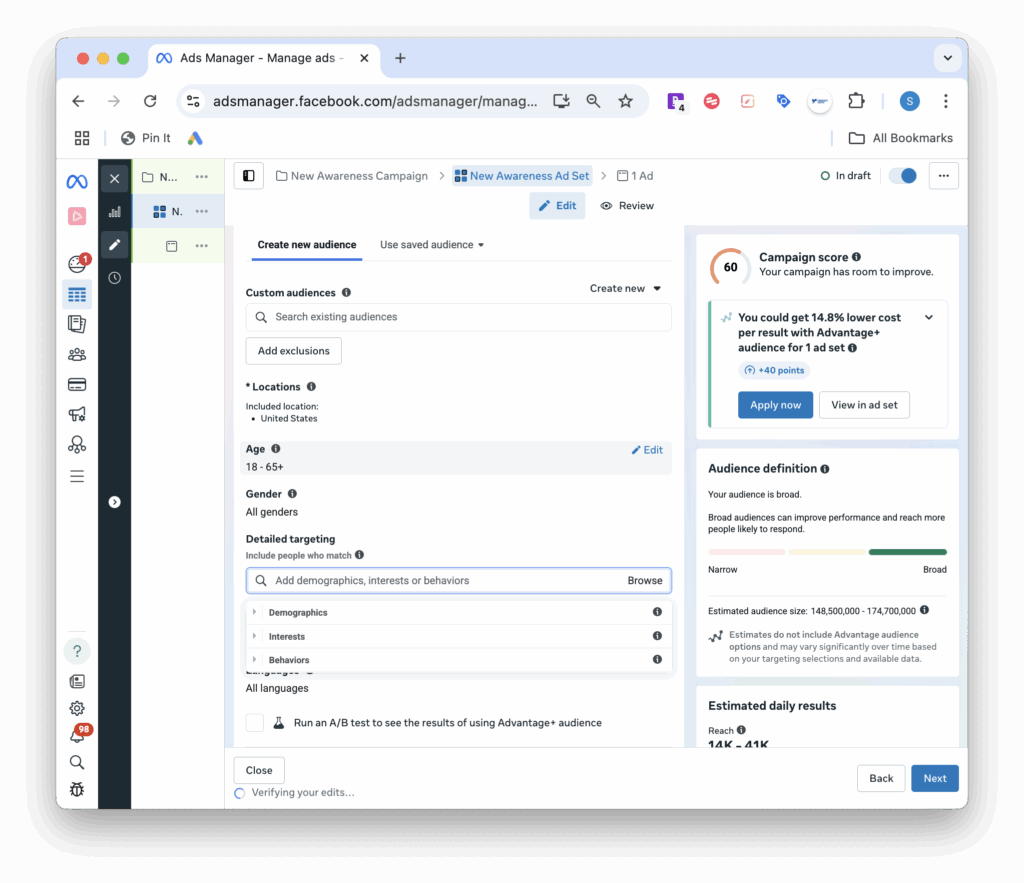
Whether you’re targeting “pet parents” or “matcha lovers,” Instagram has audience targeting to reach your dream customer. If not, custom audiences and lookalikes have your back.
But what really sets it apart? CRM match rates.
What are match rates, and why does it matter? We’re glad you asked! Match rate is the percentage of people from your CRM list that Meta can find and connect to actual accounts. Let’s say you upload a list of 1,000 people, but once the audience populates, it only has 800 people. This means your match rate is 80%. Meta, and by proxy, Instagram tends to have some of the highest match rates in the game.
This means you’ll have healthier retargeting audience sizes and a better chance of re-engaging your existing customers. In a post-iOS 14 world (yes, we’re still mourning the data losses), high match rates are more important than ever.
2. Enhanced Engagement
Instagram launched with one main goal: to make your photos look way cooler than they actually were. Instagram remains a visual-first platform to this day. Compared to other platforms, particularly its text-heavy big brother, Instagram puts up stronger engagement rates. Reels and carousels are the most engaging ad strategy for a good reason – they’re storytelling formats. They give brands space to hook customers, build narratives, and drive action without it feeling like a hard sell. With Reels’ popularity skyrocketing, it’s one of the best ways to boost engagement and reach on Instagram. 🚀
3. Higher Conversion Rate
Instagram is a shopper-first platform. Instagram Shops was one of the first fully integrated shopping experiences on social media. It allows customers to seamlessly move from discovery to purchase without leaving the app.
Product tags make shopping on Instagram entirely too easy. There’s nothing more frustrating than discovering something you love in an ad, only to have a hard time finding it on the website. Product tags remove the detective work. Consumers can tap directly on the item and be magically transported to the exact item they’re interested in. The best news? This works with organic and paid ads. Less internet sleuthing means fewer drop-offs in the conversion funnel, boosting your ROI.
Of course, that kind of ROI doesn’t just happen. You’ve got to put in the work—high-quality creatives, tight targeting, and a clear CTA are key. But once you nail that formula? Your campaigns can seriously perform.
4. Versatile Ad Formats

Instagram is so much more than just the feed, and not all consumers use it the same way. Take a more holistic approach to your Instagram advertising by using creative that’s designed for every ad placement. Stories, Reels, Explore, and more each have unique strengths. Tapping into all of them helps you reach people wherever they are on the app.
- Reels are perfect for snackable, engaging content.
- Stories feel native and immersive.
- Explore ads help you tap into discovery behavior.
- Carousel Ads let you showcase multiple products or messages at once.
💡Pro Tip! Level up your Stories by including interactive stickers on your organic content!
5. External Link Addition

One drawback is that Instagram does not allow clickable links on organic posts. This is 100% solvable when you’re running paid ads instead. You can add relevant landing pages in Ads Manager to drive traffic to your site.
Best Practices to Optimize Your Instagram Ad Spend
Now that we’ve discussed why Instagram ads work, let’s figure out how to get the best bang for your investment. Understanding how much do Instagram ads cost and managing these costs effectively will help you improve your ROI.
Create a custom image listing all the best practices discussed below
1. Explore Different Bidding Strategies
Bid strategies are a great place to start. You now know there are three kinds: spend-based, goal-based, and manual. Spend-based bidding is perfect for brands new to the platform, especially when you aren’t sure about your costs.
Advertisers with a wide range of product values often benefit from optimizing toward value instead of the number of conversions. Value optimization aims to reach users most likely to make larger purchases. This can be very advantageous if ROAS is your main KPI.
💡Pro Tip! No matter your level of Instagram expertise, your goal should be to move beyond the learning phase. This means you need 50 conversions a week per ad set. If you are not getting that many conversions, consolidate your targeting or optimize toward something lower in the funnel, such as add to carts or view content. Don’t worry, this is often just a temporary setback.
2. Align Targeting with Campaign Objectives
Your targeting and campaign objectives should go together like peanut butter and jelly. They complement each other. If your goal is to build brand awareness, exclude your existing customers. Consider using target frequency to ensure you’re hitting users often enough to have a real impact. One or two impressions aren’t going to cut it. On the other hand, conversion-based objectives should focus on retargeting and high-value lookalikes to find users who look most like their ideal customer.
💡Pro Tip! Choose your seed audience strategically. While it’s common to default to your complete list of current customers for lookalikes, don’t be afraid to get creative. Test lookalikes of high-value, repeat customers or recent customers. If you have a wide assortment of products, category-specific seeds can take your targeting strategy to the next level.
3. Connect Your Ads to Specific Landing Pages
Sending everyone to your homepage? Oof. Instead, send users to relevant landing pages that will be most meaningful for them. Your creative strategy must align with your website’s design. Your ad presents a problem. Your landing page should deliver the solution.
If your landing page doesn’t match the ad’s promise, expect Bounce City. Population: your users.
4. Leverage Instagram Creative Optimization Options
The Stories placement is particularly popular. It gives users a quick snapshot of what their friends and the accounts they follow are up to. Plus, there’s no better way to stay current on the latest memes than by checking your stories. Brands can serve their ads in between these stories, kind of like a commercial. Get the most out of Stories with these creative hacks.
- Automatic Templates. To reduce creative lift, templates can transform non-9:16 media into full-screen, vertical screens using templates. The best part? Instagram will dynamically choose which templates will work best. Full-screen experiences built for performance? Talk about a win-win!
- Caption Cards. Though Instagram is a visual channel, strategic ad copy can boost performance. If your caption exceeds 100 characters, Instagram may add a second story card with your caption overlaid on the image. Use it as a chance to boost engagement and encourage action!
- Strategy CTA Placement. If your ad has a call-to-action, Instagram may display select ad elements, such as your account name, post-click destination information, and call-to-action button, in the center of your ad, if viewers reach the end of your ad.
⚠️Just like you, Instagram has standards. It reserves the right to reject your ads if the creative violates its policies. Avoid that awkward rejection email by steering clear of overly personal messaging. Do yourself a favor and bookmark this link. You never know when you’ll need it.
5. Create Partnership Ads with Micro-Influencers
Want to dip your toes into influencer marketing but aren’t sure where to begin? Meet the micro-influencer. These creators may have smaller followings than macro and mega-influencers, but you’ll get more bang for your buck. These smaller communities ooze engagement. Take your top performers and turn them into Partnership Ads. Now you can put paid dollars behind creative that is battle-tested.
As an added bonus, influencers can bring fresh ideas and authenticity to your creative. Think of them as your SME for the latest social media trends. Pick influencers that pass your brand’s vibe check and have the engagement to back it up.
6. Analyze Competitor Ads
If you’re not spying on your competition (in a totally legal, above-board way), you’re missing out.
Check out Meta’s Ad Library to see what your competitors are running. It’s a one-stop shop to see what platforms, formats, visuals, and messaging they’re using. You can also see how often they are switching things up. Steal like a strategist, not a copycat.
7. Implement A/B Testing
Instagram advertising isn’t a one-size-fits-all platform, and that’s what makes it so fun for marketers. There are so many things you can test, but before you start jotting down copy variations and requesting new assets, make sure you have a plan. Running formalized A/B tests will help identify minute strategy adjustments that can have a big-time impact.
Here are some thought-starters to get you started.
- Ad formats (carousel vs. single image vs. Reels)
- Headlines and captions
- CTAs (Shop Now vs. Learn More)
- Audiences and placements
Just remember – test one variable at a time so you actually know what’s working. Once you find that winning combo, scale it up like the ad pro you are!
Types of Instagram Ads You Can Run
1. Image Ads

Single-image ads can appear in the user’s feed, Stories, and Reels. Yes, you can use statics to run on the Reels placement (it just takes a little automation). Supplying both sizes will allow your ad to fit seamlessly into the Instagram ecosystem. Just because it’s an ad doesn’t mean it needs to feel intrusive.
Specs: Square and vertical aspect ratios
Best practices
- Use high-resolution, visually striking images
- Keep your composition simple. Use negative space to let your product shine.
- Keep captions short and punchy. Try to hook users in the first line.
- Select a clear CTA that aligns with your campaign goal, such as “Shop Now” or “Learn More.”
2. Video Ads

Instagram video ads can also run across all placements! Video assets are a great addition to storytelling and showcasing how to use your product.
Specs: Square and vertical aspect ratios
- Feed: 6-15 seconds
- Stories: <15 seconds
- Reels: Up to 30 seconds (shorter is better)
Best practices:
- Start strong—the first 3 seconds count.
- Use motion and text overlays to maintain attention.
- Design for sound-off, but delight with sound-on. Include captions/subtitles for sound-off viewers.
3. Carousel Ads
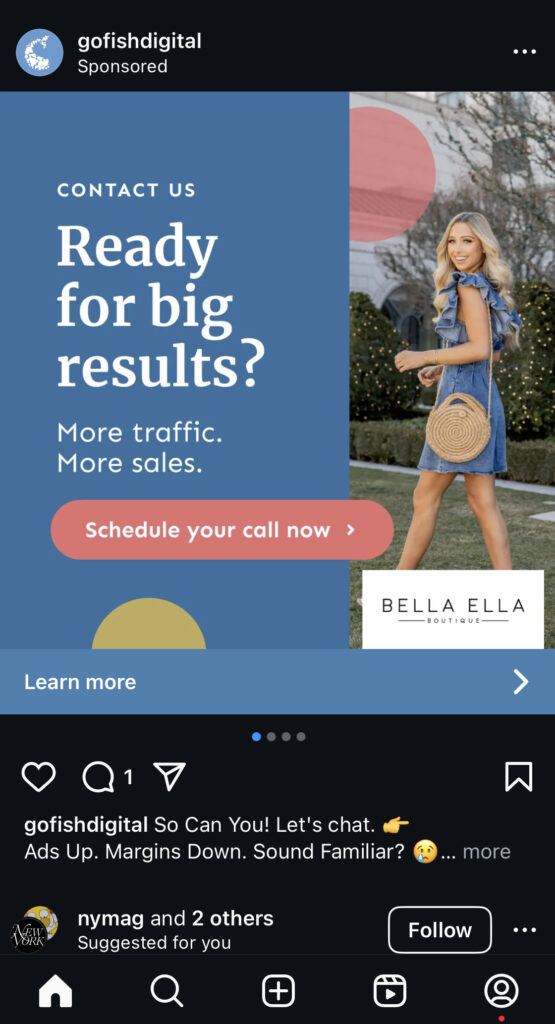
Carousel ads feature multiple images or videos that users can swipe through. You can lock the card order to tell a sequential story or allow Instagram to serve the best-performing card first.
Specs: Square and vertical aspect ratios
Best practices:
- Use consistent branding across all slides. Include a CTA on each card to keep the action flowing.
- Landing page alignment is vital. If you’re a skincare brand running a carousel ad with cards for cleansers, masks, and moisturizers, don’t send everyone to the same generic page. If someone clicks on the mask card, they should land on a page all about masks. The more relevant the experience, the more likely they are to convert.
4. Instagram Stories Ads

While you can run your single-image, single-video, and carousel units on Instagram Stories placements, these aren’t your only options. For marketers, Instagram Stories can be one of the most fun and engaging placements in their organic toolkit. You can add interactive stickers, polls, and more. Did you know you can boost these to put paid support behind them? There are some restrictions, but it could be worth the effort to make your content feel more native.
While we’re still hoping Instagram will integrate the emoji slider into Ads Manager, the interactive poll feature has been available for some time. The key to unlocking this feature is knowing it’s only available for brand awareness campaigns, specifically when targeting only Instagram Stories.
Specs: Vertical aspect ratio
Best practices:
- Use bold visuals and minimal text.
- Leverage polls, quizzes, and countdowns for interactivity.
5. Instagram Reels Ads
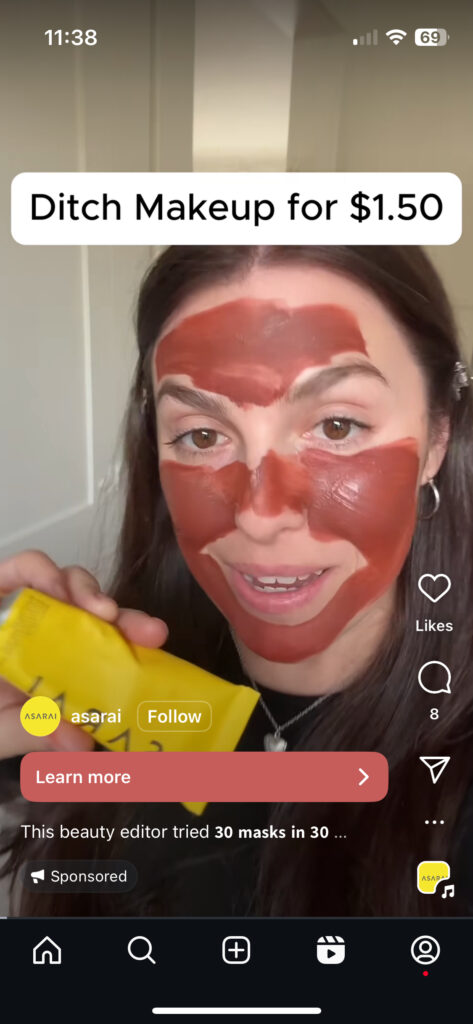
Reels Ads are one of Instagram’s most high-impact placements right now. With Reels popping up on the user’s feed, the Reels tab, and even Explore, Reels are essentially inescapable. Reels have become a core part of how users discover new content, products, and brands. The best part? People actually want to watch them.
But what exactly makes a Reel… a Reel?
To stand out, Reels ads need to feel native to the format. That means leaning into what makes Reels successful in the first place: quick cuts, trending audio, bold text overlays, and content that feels raw, authentic, and fun. This is not the place for your polished sizzle video—this is where you let your creative team play.
Specs: Vertical aspect ratio
Best practices:
- Audio is a must. Whether it’s trending audio or a strong voiceover, sound is key.
- Add text to reinforce your message visually.
- Make it entertaining and encourage engagement.
6. Explore Ads

Explore Ads are the first ad shown after a user taps on content from the Explore tab, ensuring high visibility and engagement. For marketers, this gives you the unique opportunity to reach users in discovery mode. Since these run as in-feed ads, you don’t need to do anything! Your regular in-feed creative is ready and able to do the heavy lifting.
Specs: Square aspect ratio
7. Shopping Ads

If an ad contains product tags, guess what? It’s a Shopping Ad. Product tags can transform a basic ad into a full-blown lookbook. Before you start, brands must set up Instagram Shopping and link their product catalog. Once that’s done, start tagging! No more sending users to search your site—shoppers can go straight from your ad to the Instagram Shop product page and straight to checkout. It’s as simple as that.
Best practices:
- Tag with care. Tagging too many products can make the post feel cluttered and less engaging.
- Focus on key products. Showcase items that are most likely to convert.
- Use product tags strategically. If you’re running a promotion, consider tagging products that are on sale.
8. Collection Ads

Do you have a catalog but not an Instagram Shop? No problem! Collection ads are another way brands can make their ads more shoppable. To create one, you’ll need to start by making a product set that includes all the items you want to feature in your ad. From there, start building your ad. There are a couple of instant experience templates you can use to get started.
Specs: Square aspect ratio
Best practices:
- The products in your product set should align with creative assets.
- We recommend that you include at least 50 products in your product set. This gives the algorithm enough data to learn effectively and drive performance improvements quickly.
- Don’t have 50 products? That’s okay! Just aim to include as many as possible while still keeping the selection relevant to your messaging.
Want to dig deeper into these specs? Here’s an interactive guide that will give you nitty-gritty details for all these ad types. It even lets you customize by placement.
FAQs
Instagram advertising costs vary, but on average, expect to pay around $0.75 to $2.00 per click (CPC) and $5 to $10 per thousand impressions (CPM). Costs depend on targeting, objective, competition, ad quality, and time of year. Awareness CPMs will be lower, while conversion CPMs will be higher.
Yes, Instagram ads are worth it. When campaigns are well-executed, marketers can rely on strong targeting, high engagement, and strong ROI. Visually striking content performs particularly well, making it ideal for driving brand awareness, traffic, or conversions.
Instagram ad cost is typically calculated by CPC (cost per click), CPM (cost per thousand impressions), or CPA (cost per acquisition). Your total ad spend is divided by the number of clicks, impressions, or actions to get the cost metric.
A general Instagram CPM range is typically $5–$30, with costs varying based on targeting and campaign objectives. Awareness-focused campaigns tend to have lower CPMs, usually around $5–$15, while sales-focused or conversion campaigns often have higher CPMs, ranging from $10–$30 or more.
For upper-funnel campaigns, consider how much you need to reach a meaningful portion of your audience. For lower funnel campaigns, aim for enough budget to drive ~50 conversions per week per ad set. Always build in extra for testing and optimization.
Final Thoughts
So if you’re wondering how much do Instagram ads cost, the answer is that costs can vary widely based on multiple factors. Marketers can effectively reach and engage their target audience, but as you move optimization further down the funnel, you’ll notice that Instagram ads cost increases. However, this trend isn’t exclusive to Instagram, it’s common across all advertising platforms.
To manage how much Instagram ads cost, consider adopting a full-funnel advertising strategy. This approach leverages lower CPM awareness tactics to balance out the premium pricing you’ll typically encounter with lower-funnel objectives. The result is a flywheel effect, each funnel stage complements the others, driving continuous growth without disproportionately inflating how much Instagram ads cost overall.
Additionally, consolidating your audience targeting and placements with placement-optimized creative can significantly influence how much Instagram ads cost. Avoid overly complicated targeting or unnecessary segmentation. Simple strategies often perform best, allowing you to shift your focus to creative execution. In the post-iOS 14 landscape, standout creative is essential. Invest in differentiated visuals and messaging that clearly communicate your brand’s value propositions.
Pairing your creative efforts with targeted landing pages helps you get the most from your ad spend, further optimizing how much Instagram ads cost per conversion.
Keep these insights in mind, and you’ll confidently manage your budget while running successful, cost-effective Instagram ad campaigns.
Ready to level up your social media campaign performance? Partner with AdParlor and let our team of experts maximize your Instagram spending. Let’s connect!